
SIM CMOS Inline Shrink Wrap Bundler
The SIM CMOS is a continuous-motion overlap shrink wrap bundler with inline, multi-lane infeed. Product that can be accumulated — PET bottles, cans, jars, cartons — flows straight into the machine. One roll of film wraps the pack. The ends overlap under the bundle and fuse in the tunnel, so registered printed film stays sharp for retail graphics.
Single-track lines run up to 45 cycles per minute. Dual track is about 90 packs per minute. With a diverter on three tracks, Autopack rates the SIM CMOS up to 135 packs per minute — among the most compact overlap machines in that speed range, and it uses conventional motors (no servo drives).
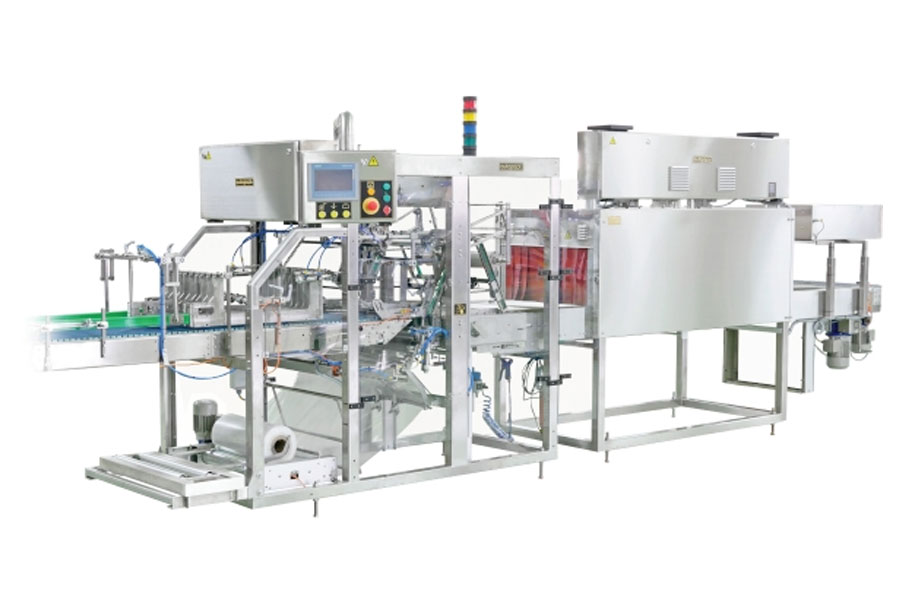
How the SIM CMOS wraps a pack
- Inline multi-lane infeed. Product arrives in one or more lanes, by accumulation or with an optional lane divider / diverter.
- Collation. The machine groups the count you set on the HMI (for example 4×3 cans or 3×2 bottles).
- Single-roll wrap. One film roll wraps the pack at a preset length. The film forms a sleeve with the overlap under the pack.
- Bottom overlap seal. No welding bar on top. The overlap is the seal — cleaner for print, one roll to change.
- Shrink tunnel. Heat fuses the overlap and shrinks the film through the pack.
- Discharge. Inline or 90° outfeed to the case packer, tray packer, or palletizer.
That is continuous motion: the pack does not stop for a seal bar, which is why CMOS outruns a welding-bar SIM on the same footprint class.
Why plants choose the SIM CMOS
Printed film without a fight. One roll and a bottom overlap are the practical way to run registered print. A welding bar cuts a seam on the top of the pack; CMOS does not.
Speed you can staff. Up to 45 cycles/min per track; three tracks to 135 packs/min. Conventional motors — not a servo-only machine.
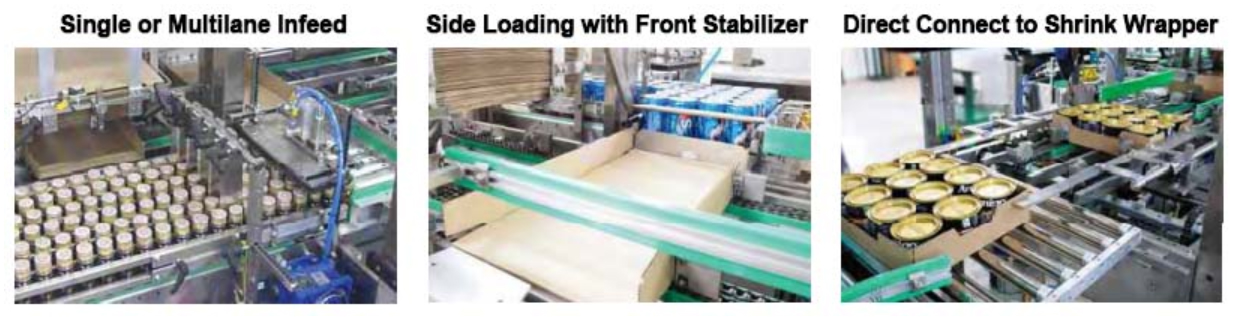
Inline, not a side-load puzzle. If bottles and cans already leave the filler in a straight line, you do not need a 90° infeed or a feedscrew.
SKU changes without a mechanic. Tool-less, quick size changeover. Pack patterns are selected on the HMI.
Smaller than most overlap systems at this speed. Autopack’s wrapper-and-tunnel package is built to save floor and energy (“faster, smaller, better pack, less energy”).
Options for the hard packs. High product stabilizer, aerosol tunnel, tear-strip, dual lane, lane divider / splitter.
At a glance
- Continuous-motion overlap shrink bundler with inline multi-lane infeed
- For products that can be accumulated: bottles, cans, cartons
- Bottom overlap seal — one film roll, built for printed / registered film
- Up to 45 cycles/min single track; ~90 dual; up to 135 packs/min three-track
- Tool-less, quick changeover
- Single, dual, or triple track
- Compact footprint vs. typical high-speed overlap wrappers
- Integrated control and user-friendly HMI (Allen-Bradley on Holland-supplied systems)
- Stainless-steel construction
- Custom infeed and discharge (inline or 90°)
Popular Options:
No. Autopack rates it among the faster overlap machines using conventional motors.
SIM CMOS is inline for product that accumulates (round bottles, cans, cartons). SLO CMOS is side infeed with a feedscrew for oval and shaped bottles that must be rotated.
Same Autopack SIM family, different seal. The welding-bar SIM uses two film rolls and a seal bar (top and bottom). SIM CMOS uses one roll, seals underneath, runs faster, and is the printed-film machine.
Yes. Bottom overlap plus a print-registration device is why plants specify SIM CMOS instead of a welding-bar SIM.
Up to 45 cycles per minute on a single track, about 90 packs per minute dual-track, and up to 135 packs per minute on three tracks with a diverter. Actual speed depends on pack size and product stability.
Bottles, cans, cartons, and other rigid items that can be accumulated in lane — PET water, beverage cans, food cans, jars, detergent, and similar. It is not the oval-bottle machine; that is the SLO CMOS
One roll of film wraps the pack and the ends overlap under the bundle. The shrink tunnel fuses that overlap. You get a tight pack and a clean surface for printed film, unlike a welding-bar sleeve that seals top and bottom.