
SIT CMOS Continuous Motion Overlap Shrink Wrap Bundler
The SIT CMOS is a continuous-motion overlap shrink wrapper with inline infeed, built for product that is already on a corrugated tray, pad, or box. Bottles, cans, jars, or bags leave a tray packer; the SIT CMOS wraps the tray in a single roll of film, seals under the pack with a bottom overlap, and shrinks it tight for palletizing.
It is Autopack’s high-speed tray overlap wrapper: up to 40 trays per minute, printed-film registration, and a compact stainless footprint. One film roll. No welding bar. Direct connection to an Autopack tray packer (or another tray loader) so the line stays in a straight shot.
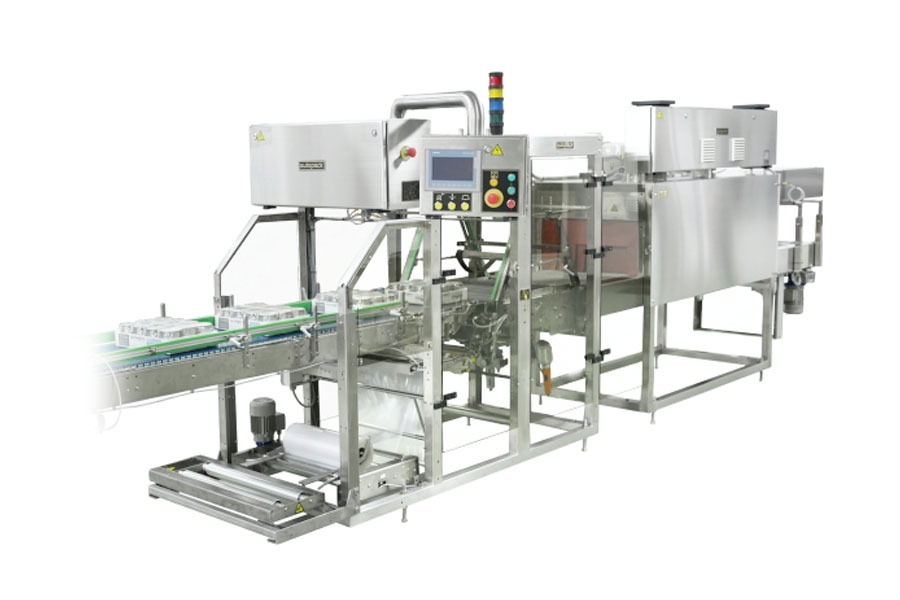
How the SIT CMOS wraps a tray
- Tray packer (upstream). A tray erector/loader (often Autopack) collates product onto a corrugated tray or pad.
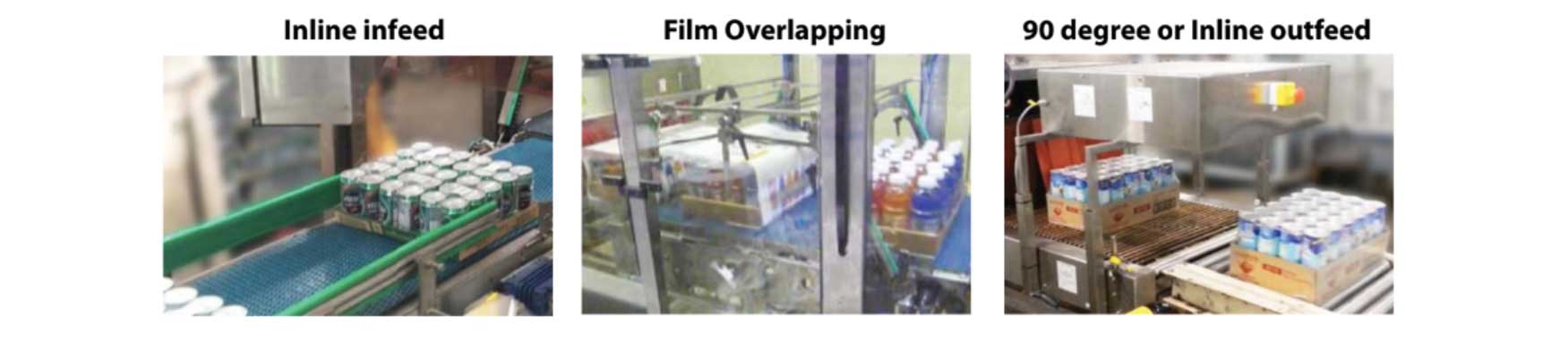
- Inline infeed. The loaded tray feeds straight into the SIT CMOS — no 90° turn required. Optional 90° discharge if the floor needs it.
- Single-roll wrap. One film roll wraps the tray at a preset length. The film overlaps under the tray.
- Bottom overlap seal. The shrink tunnel fuses that overlap. Printed graphics stay registered on the pack.
- Heavy-duty tunnel conveyor. Built to carry tray weight through heat without sagging.
- Discharge. Finished tray-and-shrink packs go to the palletizer or case conveyor.
The product is not collated on this machine. The tray is the collation. That is the difference from SIM CMOS.
Why plants choose the SIT CMOS
It is a tray wrapper, not a bottle collator. Spec it when the tray packer already did the grouping.
Printed film on a tray pack. Bottom overlap and one film roll are the practical way to run registered print on beverage and food trays.
40 trays/min in a compact line. Continuous motion, conventional motors (no servo-only machine). About twice the welding-bar SIT.
Straight after the tray packer. Inline infeed keeps the layout short. Custom infeed/discharge to match your tray packer discharge height (typically ~850–900 mm).
Built for tray weight. Heavy-duty tunnel conveyor, stainless construction, Allen-Bradley PLC/HMI on Holland-supplied systems.
Less corrugated than a full RSC case. Tray-plus-film is the usual way to cut board cost and still ship a stackable pack.
At a glance
- Continuous-motion overlap shrink wrapper for pre-loaded trays, pads, and boxes
- Inline infeed — designed to follow a tray packer
- Bottom overlap seal — one film roll, printed / registered film
- Up to 40 trays per minute
- Fast, easy changeover
- Heavy-duty shrink-tunnel conveyor
- Compact footprint vs. typical high-speed tray wrappers
- Integrated control and user-friendly HMI
- Stainless-steel construction
- Custom infeed and discharge (inline or 90° outfeed)
Popular Options:
Beverage, food, dairy, dry grocery (including bags on trays), household, and any shipper who wants a tray instead of a full case.
It is Autopack’s fast tray overlap wrapper. For loose bottles and cans, SIM CMOS is the higher pack-rate machine (up to 135 packs/min on three tracks).
Up to 40 trays per minute. Final speed depends on tray size (Autopack notes speed is highly dependent on tray dimensions).
Yes. Bottom overlap plus a registration device is why plants specify CMOS when the tray pack needs branded film.
Yes. Inline infeed is designed for a direct connection after an Autopack (or other) tray packer so trays never get handled between loader and wrapper.
Same tray job, different seal and speed. The welding-bar SIT runs about 12–22 trays/min with two film rolls. SIT CMOS is continuous-motion overlap, one roll, printed film, up to 40 trays/min.
Product already sitting on a corrugated tray, pad, or in a rigid box — bottles, cans, jars, bags. It does not collate loose bottles; that is SIM CMOS.
No. Autopack rates it among the faster overlap machines using conventional motors.
One roll of film wraps the pack and the ends overlap under the bundle. The shrink tunnel fuses that overlap. You get a tight pack and a clean surface for printed film, unlike a welding-bar sleeve that seals top and bottom.